Here Be Dragons!
As it happens, today is St. David’s Day of Wales – He was a 6th-century Celtic Christian saint.

I’ve been working with ‘dragons’ a lot over the years, and partly rooted in Royston Cave. This is a mixed bag post – Bear with me… The overarching theme? Control of historical narrative and its use to shape politics and faith… And of course! Dragons!!!

As is normal human behavior, geography matters in customs, politics, or religious impulses. Celtic Christianity carried different streams of influence from further off Rome –
Though scholars debate this issue, I myself can see this as a reality playing out on the ground, even in today’s world. Distance and prior customs of centuries will color the local population’s tendencies. Celtic Christianity did and does exist…
The Atlantic Archipelago, which includes the islands of Britain and Ireland, which are the largest livable landmasses. The Anglo-Celtic Isles comprise a vast collection of over 6,000 islands (mostly uninhabited due to tidal wash).
Instead of the above, I’ll use the poetic term, the Isles of Albion, all of which have/had distinct microcosm cultures.
So, yes, Celtic Christianity was recognizably different from Rome. St. Augustine (first Archbishop of Canterbury) came to the Kingdom of Kent in order to convert its powerful King, Æthelberht, who would benefit from trade to Western Europe via increased ties to Rome.
South East Kent in England has always been a ‘garden’ – wheat was grown and distributed across Roman provinces prior to 410 CE, when Rome officially left Britain. Afterwards? The merged culture of Romano Britons led their own lives… 180 years later, Papal Rome wanted back in on British soil in a bigger way…
Though Christianity was the official religion of the Roman Empire from 325 CE onward, local customs of any region played a strong role in the practices of faith. ‘Roman Britain’ was a Celtic Christian world that lived side by side with indigenous paganism out of its pre-Roman and pagan Roman past. Perhaps and most certainly, not always friendly: But like today, life was messier than we think… Lives and people are more complex… Despite proclamations of governments.
Like the date of 1066, when the Anglo-Saxons were overthrown by the Normans in a seismic and violent shift. 596/597 CE heralded a new age of change over Celtic Christians and Rome’s desire to reform the Isles of Albion.
Rome’s Emmisary:
The infamous Pope Gregory is known for the character assassination of Mary Magdalene by reducing her to a ‘streetwalker.’ However, and thankfully, in 1969, the papacy reversed this as having been an ‘academic’ mistake. But the damage was done… And has never been reversed.
In 2016, Pope Francis elevated the mandatory memorial of St. Mary Magdalene to a feast day on July 22, the same liturgical rank as the apostles. Known as the “Apostolorum Apostola” (Apostle to the Apostles), this decree by the Congregation for Divine Worship highlights her role as the first witness to the Resurrection.
Again and sadly, too late in the minds of Reformation Christians and post-Schism Christianity of the 11th century when the Catholic church split into East and West. She has never been a streetwalker in the Eastern Orthodox Church. It’s just not a conversation with them at all…
Pope Gregory’s intentions seem clear… He sent Augustine to Celtic Albion in order to change it… From Ireland to the Shetlands, England to Wales, the push to form, as if from moldable clay, was on…
One major difference between the Celts and Rome? That held on with persistence? Marriage… I have always maintained that Mary Magdalene was married to Jesus and have found original evidence over the years as the foundation for my assertions.

In the early medieval period (roughly 500–1100 AD), priests in the British Isles were frequently married, and this practice was one of the most significant points of tension between local “Celtic” traditions and the centralizing authority of Rome. But Augustine did try to change the British Isles, and his doctrine would eventually succeed. Distance was the saving grace of the Isles of Albion, but it did not last forever… And the 1066 invasion brought about the greatest changes.
None of this is simple, and history is not cut and dry… Classroom modules try to tie up the big issues in 45 minutes. Leaving out all the chaotic and in-between dimmer-switch changes across time. But the in-between does matter.
Saint David is considered by many to be a true Celtic Christian saint. As a dynamic individual, he founded 1200 sites. He had passed in 589 – Before Augustine arrived in 597 – Perhaps the vacuum of David’s loss had been noted by Rome? Saint David was bound to Wales, but with human travel and the ‘bleed through’ phenomenon, his reach exceeded the boundary lines of kingdoms. He was a true influencer…
By contemporary standards, he was still very conservative. It’s always a mistake to judge the past with today’s lens – By doing so, we can’t ponder what motivated our ancestors.
One of the customs of Wales on St. David’s Day? Carry daffodils and celebrate the humble leek – And wave the flag of the Red Dragon of Wales!
Legend has it that a duel between a White Dragon and a Red Dragon clashed for rule over the kingdom… The Red Dragon won…

Who were the dragons? They were extraordinary individuals… Men of iron whose epic swords of name were forged in flames… Sages of the tradition of Merlin and the wisdom of their Ladies of the Lake. Family lines encompassing the fire of will and the courage of lions.
Heroic figures of legend and the mists of Roman Britain… Merged with imagery of Saxon, Norse, and Danish dragons… The culture of the dragon stretched across Europe to Transylvania… And of course, around the world… But that’s for another day…
Human beings love a good yarn about dragons!!! 

Royston Cave is the intersection point of two legendary energy lines, both termed as the dragon energy of the land, of England… The Michael Line and the Mary Line, both converge in Royston Cave. I have shared two versions of available maps with the lines both showing Royston and accompanying different sites…
Michael and Mary Ley Lines cross into Royston Cave and are described as ‘dragon energy of the land’ Note the crowned figure of St. Catherine above the name ‘Royston’ – Photo Credit: This map of the St Michael Line (also known as the Michael and Mary ley lines) was originally conceptualized by author John Michell and later dowsed and mapped in detail by Hamish Miller and Paul Broadhurst.
Michell first proposed the existence of this major alignment in his 1969 book, The View Over Atlantis. However, the specific version of the map shown below, which includes “earth currents” and mentions a series of marked Ordnance Survey Landranger maps, is associated with the work of Miller and Broadhurst. They spent ten years following and dowsing the line’s path across southern England, documenting their journey in their 1989 book, The Sun and the Serpent.

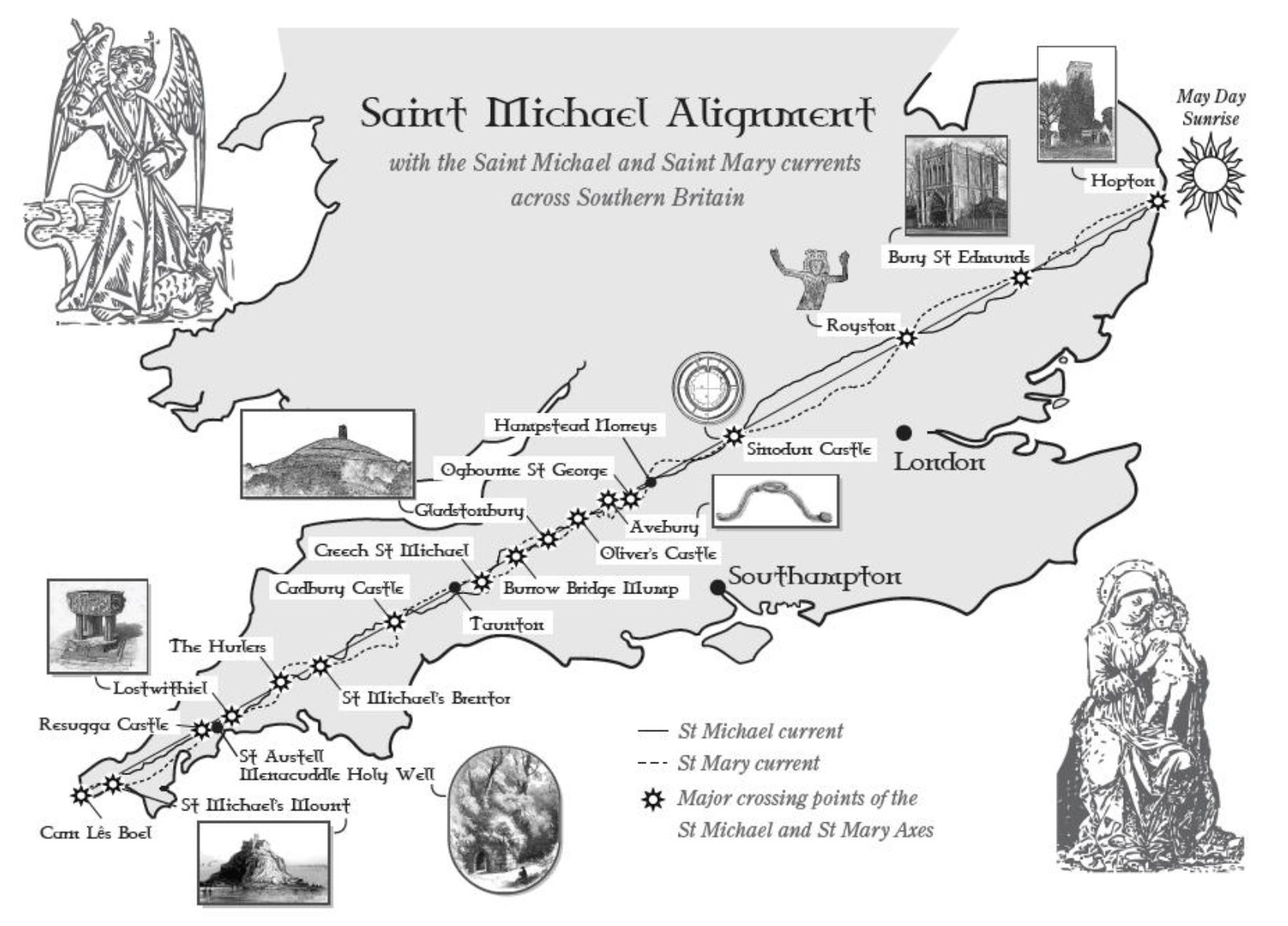
Based on John Michell’s work in the 1960s – Dowsed and mapped by Hamish Miller and Paul Broadhurst. Expanded by Hamish Miller & Paul Broadhurst (1989)
Also, dissecting the cave? The Greenwich Meridian…


Still, the smoke of dragons can be seen today in Wales, in England, and across the Isles… Scratch the surface, and fire springs forth like water…
Regardless of boundary lines, the dragon reaches all of the misty isles of the North Atlantic. All one has to do is scratch the surface, and dragons can still be found breathing fire lines of energy across the ancient Isles of Albion…

Happy St. David’s Day, Wales!
by Gretchen Cornwall ©
Thank you for your interest and for following my work. Please share, and if you find value, consider being a patron…
Thank you to my Patrons for their support:
Thank you to my YouTube Followers for your support by Liking, Sharing and Subscribing! A side topic on my ties to the Árpád dynasty of Hungary and the Order of the Dragon in Transylvania: https://www.youtube.com/watch?v=Cx7EGU2eZdY&t=1452s